Tuesday, August 27, 2013

May 30,2013: Turkey finds sarin gas in homes of suspected Syrian Islamists – reports

Americans Stand with Israel
by Bee Sting
Tuesday, August 27, 2013

The conflicting evidence as to which side used chemical weapons - Assad's military, or the "Free Syrian Army" (rebels) may go on longer than it will take Syria to end its Civil War and restore peace within its borders.

However, here are two reports released earlier this year, pointing the finger to the FSA as acknowledging they had (and threatened to use) chemical weapons:
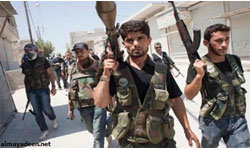

US-backed Terrorists Renew Threat to Use Chemical Arms against Syrians and Damascus Gov’t

Date and Time:2 January 2013 - 11:31 

Political Advisor to the so-called Free Syrian Army Bassam ed-Dade acknowledged FSA’s chemical weapons capability, and renewed the rebels’ threat to use the lethal weapons against the Syrian Army.
Syrian RebelsSpeaking to Turkish Anadolu News Agency, ed-Dade said that the FSA has achieved the capability to produce chemical arms.
He said the FSA has acquired the raw materials for the production of chemical weapons and has achieved the capability to produce chemical weapons using some defected members of the Syrian army.
He added that the group will use these lethal weapons to target bases and centers of the Syrian government if necessary.
Late last month, armed rebels released a second film on the Internet which shows them testing a poisonous chemical agent on an animal in Western Syria.
The footage shows terrorists testing a chemical substance on a rabbit in the coastal city of Latakia, the Lebanese television al-Manar reported.
On the same day, the armed rebels used chemical weapons in their attacks against the Syrian army in Darya district of Reef (outskirts of) Damascus.
“The terrorists have already thrown three cube-shaped plastic bags towards the (Syrian) army’s forces that killed seven forces due to the gases emerging from the bags,” a commander of the Syrian Presidential Guard told the Iran-based Arab-language Al-Alam news channel at the time.
The commander noted that a yellow button is installed on the bags and by pushing that a yellow gas came out and those who inhaled it died after nearly one hour.
Since several weeks ago, different media had reported about the presence of chemical weapons in Syria and the possibility of its use by armed rebels.
Terrorists have tried hard in the last several days to make Syrian cities unsafe for citizens, but the army has purged them from most neighborhoods and districts, killed tens of them and arrested many others.
Syria has been experiencing unrest since March 2011 with organized attacks by well-armed gangs against Syrian police forces and border guards being reported across the country.
Hundreds of people, including members of the security forces, have been killed, when some protest rallies turned into armed clashes.
The government blames outlaws, saboteurs, and armed terrorist groups for the deaths, stressing that the unrest is being orchestrated from abroad.

Syria: "Conflicting Views"

Americans Stand with Israel
by Bee Sting
Tuesday, August 27, 2013

Links to headlines on Syria:

Syria says it will defend itself against attack - YNet news
"Syrian sources said Tuesday that western powers told the opposition to expect a strike against Assad's forces within days.

Syria has accused US Secretary of State John Kerry of lying by claiming there is "undeniable" evidence of a large-scale chemical weapons attack in Syria likely carried out by the regime.
 
A statement on the state-run Syrian Arab News Agency says Kerry's insistence on "jumping over" the work of UN experts in Syria shows that the US has deliberate intentions to exploit events.".....
"Defense One" has the following article on the Administration's view of Syria: Kerry Makes the Case for Military Action in Syria and below, a commentary written August 25th:

The following report was posted Sunday, August 25, 2013:


Syrian state TV says soldiers find poison gas in tunnels used by rebels.
August 25, 2013
H/T - "Flavio58"

Syrian state television said soldiers found chemical weapons on Saturday in tunnels that had been used by rebels, deflecting blame for a nerve gas attack that killed hundreds this week and heightened Western calls for foreign intervention.

The
United States said it was realigning naval forces in the Mediterranean to give President Barack Obama the option of attacking Syria, and a senior U.N. official arrived in Damascus to seek access for inspectors to the gas attack site.

Opposition accounts that between 500 and well over 1,000 civilians were killed by gas fired by pro-government forces, and video footage of victims' bodies, have stoked demands abroad for a robust, U.S.-led response after 2-1/2 years of international inaction on a conflict that has killed 100,000.

International medical humanitarian organisation
Doctors Without Borders (MSF) said on Saturday that three hospitals it supports in Damascus reported receiving 3,600 people displaying neurotoxic symptoms within less than three hours on Wednesday.

Of those patients, 355 died, and it had sent
7,000 vials of atropine, a nerve agent toxicity antidote, to the area, it said.

In an attempt to strengthen government denials, state news agency
SANA said soldiers "suffered from cases of suffocation" when rebels used chemical weapons against them in the Damascus suburb of Jobar.

It said clashes were still raging in the area but that the army had advanced and found "chemical agents" in rebel tunnels.

State television said rebels used poison gas
"as a last resort" after government forces made "big gains" in Jobar.

But footage did not appear to show evidence of chemical weapons. It showed five blue and green plastic drums, normally used to transport oil, lined against a wall in a room, as well as several rusty mortar bombs and grenades.

Next to them were several rolls of tape, rope and some gas canisters, normally used for domestic ovens. Gas masks were seen near some vials labelled "atropine".

The presenter said that these images were proof that the rebels had used chemical weapons but did not say which of the items contained them.


Activists say
President Bashar al-Assad's forces fired nerve gas projectiles into Jobar and other suburbs before dawn on Wednesday. Later in the week, activists crossed front lines around Damascus to smuggle out tissue samples from victims.

Leader of the opposition Syrian National Coalition Ahmad al-Jarba and the head of the rebel Free Syrian Army General Salim Idriss denied on Saturday that rebels had used chemical weapons.

At a press conference in Istanbul Idriss said the rebels would respond to the attack but would not commit "similar crimes", referring to chemical weapons.

Jabra said the "most important cause" of the attack was the lack of action by the international community, the West in particular, and its silence.

INTELLIGENCE EVIDENCE


Obama has long been hesitant to intervene in Syria, wary of its position straddling fault lines of wider sectarian conflict in the Middle East, and he reiterated such reluctance on Friday.

But, in a development that could raise pressure on Obama to act, American and European security sources said U.S. and allied intelligence agencies had made a preliminary assessment that chemical weapons were used by pro-Assad forces this week.

Major world powers - including Russia, Assad's main ally which has long blocked U.N.-sponsored intervention against him - have urged the Syrian leader to cooperate with a U.N. inspection team that arrived on Sunday to pursue earlier allegations of chemical weapons assaults in the civil war.

U.N. High Representative for Disarmament Affairs Angela Kane arrived to Damascus on Saturday to press for access to areas of Damascus suburbs said to have been targeted on Wednesday.

"The solution is obvious. There is a United Nations team on the ground, just a few kilometres away. It must very quickly be allowed to go to the site to carry out the necessary tests without hindrance," French Foreign Minister Laurent Fabius said on Saturday during a visit to the Palestinian territories.

Foreign Minister Guido Westerwelle of Germany said it expected Russia to "raise the pressure on Damascus so that the inspectors can independently investigate".

President Hassan Rouhani of Iran, Assad's most powerful Middle East ally, acknowledged on Saturday for the first time chemical weapons had killed people in Syria and called for the international community to prevent their use.

CONFLICTING VIEWS

Among the military options under consideration are targeted missile strikes on Syrian units believed responsible for chemical attacks or on Assad's air force and ballistic missile sites, U.S. officials said. Such strikes could be launched from U.S. ships or combat aircraft capable of firing missiles from outside Syrian airspace, thereby avoiding Syrian air defences.

Obama's caution contrasted with calls for action from NATO allies, including France, Britain and Turkey, where leaders saw little doubt Assad's forces were behind the chemical attack.

While the West accused Assad of a cover-up by preventing the U.N. team from heading out to Damascus suburbs, Russia said the rebels were impeding an inquiry and that Assad would have no interest in using poison gas for fear of foreign intervention.

Igor Morozov, another senior pro-Kremlin lawmaker, told Interfax news agency, "Assad does not look suicidal. He well understands that in this (chemical attack) case, allies would turn away from him and ... opponents would rise. All moral constraints would be discarded regarding outside interference."
Alexei Pushkov
, pro-Kremlin chairman of the international affairs committee in Russia's lower house of parliament, said, "In London they are 'convinced' that Assad used chemical weapons, and earlier they were 'convinced' that there were weapons of mass destruction in Iraq. It's the same old story."
Russia said last month that its analysis indicated a projectile that hit the city of Aleppo on March 19 contained the nerve agent sarin and was most likely fired by rebels. 


(Additional reporting by Megan Davies in Moscow, John Irish in Paris, Madeline Chambers in Berlin, Yeganeh Torbati in Dubai, Asli Kandemir and Dasha Afanasieva in Istanbul and Washington bureau; Writing by Mark Heinrich; Editing by Louise Ireland)


American attack coming, says John Kerry

Americans Stand with Israel
by Bee Sting
Tuesday, August 27, 2013
U.S. strengthens naval force along Syria's coast

The suggestion that American troops now attack Syria are largely debated all afternoon and into the evening hours, with one Poll demonstrating that only 9% of Americans believe the United States should become involved in yet another Islamist war!  
Americans do not lack sympathy for the innocent Syrians dying, and we are in shock, grieving over the loss of life because of the use of chemical weapons.  But, many innocent lives have been lost since this war began over two years ago; we hear over 100,000 people. However, it is a fact that the Obama administration cannot by-pass Congress (again).  Article One, Section Eight of the Constitution says "Congress shall have power to ... declare War".  Obama did not present his case before sending troops to Libya. 
What Americans are very leary of is having an attack on Syria turn out to be another failed "Libya".  We are not very trusting of this administration's decisions when it boils down to "foreign" policies.  Nor, do we support Islamists terrorists, who seem to accumulate daily, sprinkling their hatred and cowardly murders in just about every country in this old world. It is clear they cannot live in today's society, as they attempt to bring us all back into the 7th century. 
President Obama must present his case before Congress and the American people.  For the opinions of others, see:  (Syria: Everyone Has an Opinion, but The Road to Damascus Starts in Tehran).  And, please take a moment to read Fresno Zionism's: Syrian crisis not serious (yet)


Kr8 (Israeli News) Translated from Hebrew:

American attack coming, John Kerry: "There was a massacre in Syria chemical, we will exploit the law"
U.S. Secretary of State John Kerry carried the night with a clear statement that there is no doubt performed chemical attack Syria, and that the Red Line "of the United States with regard to cross state intervention. "There is nothing more significant than that on the agenda," it is a moral slump can no longer be denied "

John Kerry - screenshot
Kerry explained: "use of chemical weapons can not occur without consequences"

U.S. Secretary of State, John Kerry, said in a statement that there is no doubt that Syria used chemical weapons, and said that Obama believes that there must be a reaction to it. "There is nothing more significant than that on the agenda", said Kerry. "This is a moral low Lhchsh"socnoiot can no longer news source:

U.S. Secretary of State John Kerry carried the night (B) a statement which said that there is no doubt performed chemical attack Syria, and that the Red Line "of the United States with regard to cross state intervention.

"The killing of women and children with chemical weapons is a moral slump can no longer be denied," said Kerry.

Reason that the world has completely abandoned chemical weapons. There is a reason that so many countries have stopped the use of weapons other. There is a reason why Obama made clear that global norms can not be violated without repercussions. "

Kerry said last night talking to heads of state from around the world and watch videos distributed over the network. "I can not get the description from my mind, images of entire families dead in their rooms, bodies, people suffer. No way anyone could fabricate these pictures," he demanded. "It is true that convincing. Certainly - used chemical weapons in Syria."

He added that the conduct of the government and its cover-up attempts to leave no doubt that used chemical weapons in Syria. While Kerry said that the UN investigation and made sure that the parties did, but noted that the U.S. government has information that the government can carry out this attack.

Syria since the fighting began two years ago and a half, many in the Western world were divided as to intervene in the country. In recent months, the death toll rose significantly in the country, respectively criticism of the non-intervention.

In recent months surfaced question is whether the "red line" that defined Americans who had attacked the army of relief in Syria, remains unchanged. Following reports on the use of chemical weapons against civilians in the suburbs of Damascus collected over 1,300 deaths, including many children, increased discussions in the United States and began forming a coalition in support of the strike.

On the other hand, Russia and Iran warned against the attack that could "roll the entire region to war" and explained that "there is no evidence for chemical weapons in Syria."

Deputy Minister of Information Assad's Baath Party, passed to the - key, even threatened that if the U.S. would intervene in the war, Israel would suffer a direct attack would include Iranian involvement, Lebanon, and Iraq.

Egypt’s Military: Doing What Germany’s Should Have Done in 1933

Americans Stand with Israel
by Bee Sting
Tuesday, August 27, 2013

This is one of the best commentary's and tribute to the Egyptian people that I've read since Morsi was first removed from his short reign as "President" of Egypt.  Enjoy!  

Intercollegiate Review
August 16, 2013
By 
Egypt
Thirty million people in the streets of Egypt, with the help of the Egyptian military, have saved the United States from the consequences of its disastrous policy of supporting the Muslim Brotherhood since President Barack Obama came to office. Just months after his inauguration in 2009, Mr. Obama appeared in Cairo to address the Muslim world. He ensured that members of the Muslim Brotherhood were seated in the front row of the auditorium at Cairo University. Since the group was still officially banned in Egypt, no one from President Hosni Mubarak’s administration could attend. The message from the seating arrangement was unmistakable: even at the price of snubbing his official host, Mr. Obama recognized the Muslim Brotherhood as a legitimate player in Egyptian politics. Already, this was clearly interference in the internal affairs of the Egyptian state.
Former British ambassador Charles Crawford later characterized Obama’s quixotic address in the following way: “It boiled down to a well delivered speech full of clever emollient phrases that ultimately sent a message of appeasement to militant Islamist tendencies: Under my restrained leadership the United States will respect and accept conservative forms of Islam. Even if Islamism gets too aggressive we don’t plan to do much about it.”
Why would the United States want to give the green light to militant Islam? Wasn’t militant Islam, after all, the problem? Of course, President Obama has never publicly admitted that it is as a form of the “violent extremism” he opposes. But perhaps the Obama administration thought there was no alternative, or perhaps it was simply ignorant of the true nature of the Muslim Brotherhood. Most likely it thought that the Brotherhood could be tamed if it were given political responsibility. At any event, its representatives said some extraordinarily strange things. At a House Intelligence Committee hearing on February 10, 2011, Director of National Intelligence James Clapper described the Muslim Brotherhood as a “largely secular” organization with “no overarching agenda.” This was a rather unusual characterization of a group whose motto is: “Allah is our objective. The Prophet is our leader. The Qur’an is our law. Jihad is our way. Dying in the way of Allah is our highest hope.” If that is secular, what might the religious be?
As for an overarching agenda, the de facto spiritual head of the Muslim Brotherhood, Sheikh Yusuf al-Qaradawi proclaimed: “Islam is a comprehensive school of thought, a creed, an ideology, and cannot be completely satisfied but by [completely] controlling society and directing all aspects of life, from how to enter the toilet to the construction of the state.” That means the rule of sharia (Islamic jurisprudence), to which the Muslim Brotherhood has been dedicated since its inception in 1928. The other objective is the restoration of the universal caliphate. The vehicle for doing both is establishment of a one-party totalitarian state.

Totalitarians Don’t Share Power
The totalitarian parties on which the Muslim Brotherhood was modeled – Lenin’s Communists, Mussolini’s Fascists, and Hitler’s National Socialists – showed no inclination toward moderation once having obtained political power. All of them remained true to their principles. Once in power after Mubarak’s overthrow, President Mohammed Morsi gave a hint of what was to come by openly calling for Shaykh Omar Abdel-Rahman’s repatriation to Egypt from the U.S. federal prison in which he is incarcerated. The famous blind Shaykh was considered the spiritual inspiration behind the 1993 World Trade Center bombing and is serving a life sentence in connection with a subsequent plot to bomb New York landmarks and tunnels. Might this have been a sign of trouble to come?
In January, a congressional delegation, including Senators John McCain and Lindsey Graham, were in Cairo visiting President Morsi when an embarrassing pair of videos appeared on the site of the Middle East Media Research Institute (MEMRI), documenting the virulent anti-Semitism Morsi had expressed in campaign appearances in 2010. In a September, 2010 interview, Morsi gave a preview of what Egypt’s approach to Israel might be:
Either [you accept] the Zionists and everything they want, or else it is war. This is what these occupiers of the land of Palestine know – these blood-suckers, who attack the Palestinians, these warmongers, the descendants of apes and pigs…We must confront this Zionist entity… We want a country for the Palestinians on the entire land of Palestine, on the basis of [Palestinian] citizenship. All the talk about a two-state solution and about peace is nothing but an illusion…
In another 2010 appearance at a rally in his hometown in the Nile Delta, Morsi said:
We must never forget, brothers, to nurse our children and our grandchildren on hatred for them: for Zionists, for Jews.”  Morsi added that Egyptian children “must feed on hatred; hatred must continue… The hatred must go on for God and as a form of worshiping him.
Everyone in the U.S. delegation got terribly embarrassed over these indiscretions but cleared their throats and continued their trip after President Morsi assured them that the remarks were taken out of context. What might that context have been? Could it have been the context of the Qur’an with its proclamations of everlasting curses upon the Jews? Or perhaps the context of the Muslim Brotherhood program itself – or of its Hamas branch which promises in its charter to eliminate Israel? In either case, how anyone could have been surprised by what Morsi had said after more than eight decades of such rhetoric from the Muslim Brotherhood and its branches must have been in a state of either willful or blissful ignorance. Nonetheless, support from the United States continued. Secretary of State John Kerry met with Morsi in March when he released $250 million in American aid, with promises of more to come.
The only way the United States could have behaved in the way in which it has was by not taking the principles of the Muslim Brotherhood seriously. We still don’t, which explains the many lamentations over Morsi’s downfall (such protestations were notably absent when Mubarak fell in much the same way). Even intelligent commentators like Fouad Ajami can make statements that, “When the Obama administration could not call the coup d’état by its name, we put on display our unwillingness to honor our own democratic creed…” Come again? Since when does our democratic creed require support for the restoration of a party whose principles are inimical to that creed and to the underlying principle of democracy that all people are created equal?
Bernard Lewis predicted this mess when he said that the rush to early elections after the fall of Mubarak would lead, as did similar events in the Weimar Republic, to the ascension of the most dangerous elements society – meaning victory for the Muslim Brotherhood. In an interview with David Horowitz in the Jerusalem Post (February 25, 2011), Lewis cautioned that the discourse in Egypt is still “religiously defined” and that “the language of Western democracy is for the most part newly translated and not intelligible to the great masses.” How many Egyptians, for instance, actually believe that Copts and Muslims, men and women, believers and nonbelievers, are equal—to say nothing of Jews and Muslims? Pressing for elections now, he warned, could lead to catastrophe, as only religious parties are well enough organized to take advantage of them. (Lewis preferred first to see the development of local self-governing institutions.) Therefore, he said, “I don’t see elections, Western-style, as the answer to the problem. I see it rather as a dangerous aggravation of a problem. The Western-style election…has no relevance at all to the situation in most Middle Eastern countries. It can only lead to one direction, as it did in [Weimar] Germany, for example.” He was right. True to form, once in power, the Muslim brotherhood and Morsi went methodically about trying to monopolize power. Morsi assigned himself powers that a Pharaoh would have envied.
Sudanese writer Al-Hajj Warraq, got it exactly right in an Egyptian television interview last year. He said:
Democracy is about more than just the ballot box. Democracy is a culture engraved upon the cerebral box before it is the ballot box. One cannot talk about freedom in the absence of free minds. The tragedy of the Arab Spring is that when the tyrannical regimes fell, the fruits were reaped by movements that preach closed-mindedness, rather than free thinking. The outcome will be regimes that are worse than those that were toppled.
Apparently, the Egyptian people – at least the 30 million who were in the streets marching against Morsi – agreed with him. Unfortunately, the United States has not.
When Hosni Mubarak was arrested in 2011 after his overthrow, no United States senators visited him in prison or in his prison hospital. Why not? He had been an ally of the United States for almost three decades. The answer is that such a visit would have clearly telegraphed to the Egyptian people that the United States supported Mubarak’s restoration.

Why are Americans Backing the Muslim Brotherhood?
Likewise, what were the Egyptian people expected to make of the visits earlier this month by Senators McCain and Graham to Mohammed Morsi under house arrest and to, of all people, the Deputy Guide of the Brotherhood, Khairat al-Shater, also under arrest? No matter what intentions Senators McCain and Graham may have had, the choreography of the visits clearly indicated support by the United States for a Muslim Brotherhood restoration. On top of that, President Obama has now canceled the long-planned military exercises with the Egyptian military, further expressing his disapproval. These actions obviously encourage and incite the pro-Morsi opposition. The Brotherhood will be less likely to reach an accommodation with the new government because of them.
However, accommodation is not in the cards, anyway. The Muslim Brotherhood thought, no doubt, that with its accession to power in Egypt, arguably the most important Arab country, it was well on its way to realizing its millenarian dream of expansion and the reconstruction of the caliphate. Arab spring eruptions elsewhere in the Middle East were also going its way. Therefore, to lose the pinnacle of power in Egypt places its members in a life or death struggle. Since this struggle is at its heart every bit as ideological as were the struggles in the Weimar Republic in the 1930s or the struggles in Imperial Russia in the 1917, deploring violence and calling for reconciliation simply makes the United States appear naïve and totally disconnected from the ground truth of what is actually taking place. (Saudi Arabia and the UAE understand what is going on, which is why they are willing to pony up $12 billion in support of the new government. They are relieved that the Brotherhood’s imperial project, of which they were intended victims, has been thwarted for the time being.)
In this struggle for power, some people will win; others will lose, but it is important enough that both sides are willing both to take and to lose lives to reach their objectives. Tut-tutting on the sidelines makes the United States appear ridiculous. Instead of just deploring violence, we should be appraising the character of the moral principles animating the two sides in this conflict and supporting the side that more closely comports with our own. And yes, that may require the choice of a lesser evil.
Unfortunately, the German military did not move against Adolph Hitler when he became Chancellor of Germany in 1933. Had they done so, Europe and the United States would have been spared a world of woe. Had that happened, would the American government have tried to intervene at the time, insisting on a restoration of Hitler, who had been democratically elected by a plurality of the German people? Would we have insisted that our democratic creed required us to do so? These questions answer themselves. We would have been grateful to the German military for doing so. We should likewise have some appreciation for what the Egyptian military has done to save its country and, by the way, preserve U.S. strategic interests in that area of the Middle East.
But what about the transition to democracy? Maybe the new government will be able to make one, but most likely, at least for the foreseeable future, it may not be able to. That will depend on the underlying conditions of which Bernard Lewis and Al-Hajj Warraq spoke. In any case, as Jean Kirkpatrick taught us long ago, an authoritarian regime is always preferable to a totalitarian one.

Robert Reilly is a Senior Fellow at the American Foreign Policy Council. He has taught at the National Defense University and has written for The Wall Street Journal, National Review, Claremont Review of Books,and The Washington Post. He has served in the White House as Special Assistant to the President (1983-85) and was Senior Advisor for Information Strategy in the Office of the Secretary of Defense (2002-06). He is a former Director of the Voice of America and is a member of the board of the Middle East Media Research Institute. Mr. Reilly is the author of Surprised by Beauty: A Listener’s Guide to the Recovery of Modern Music (2002). His most recent book, The Closing of the Muslim Mind: How Intellectual Suicide Created the Modern Islamist Crisis, was published by the Intercollegiate Studies Institute in 2010.


Monday, August 26, 2013

Blog: Point of no return

Americans Stand with Israel
by Bee Sting
August 26, 2013 - Monday

Four years of blogging have piled up more "favorites" in my "bookmarks" than I'll ever be able to review and there just never seems to be enough time to remove hundreds of saved links.  However, today I began searching for an old link I had used (approximately three years ago) when the topic of Iraq's Jewish artifacts were to be returned to Iraq, instead of its rightful owners.  To my surprise, after an hour's search, it came to me that part of the name of the blog had the word "point" in its title.   The moment I typed in Google search "point - Iraqi Jews" the blog appeared and I found an old friend!.  I have added "Point of no return" to my "links" on the sidebar for easy access.  Here is an introduction to a remarkable site that you, too, may wish to save and forward to your friends.:

still photographs of Ezekiel's shrine taken in Iraq in 2010/2011 are exclusive to Point of No Return (we are grateful to the senders). They show the shrine in a parlous state of repair.

Point of no return
Information and links about the Middle East's forgotten Jewish refugees, updated daily
Click picture for Facebook page

http://jewishrefugees.blogspot.com/

Outrage: U.S. Returning Artifacts Looted from Iraqi Jews to Iraq, Instead of Lawful Owners

Americans Stand with Israel

by Bee Sting
Monday, August 26, 2013

US soldiers look at a painting 24 April 2003 as workers at Baghdad's Archaeological Museum carry in some of the recovered items that had been looted following the US-led invasion to the Iraqi capital city. (AFP Photo)

PJ Media

by
HAROLD RHODE
August 26, 2013

Outrage: U.S. Returning Artifacts Looted from Iraqi Jews to Iraq, Instead of Lawful Owners

Like returning artifacts to Germany, had they never renounced Nazism. This following a heroic effort to save them by Dick Cheney, Natan Sharansky, Richard Perle, and me, among others. (Sign the petition to stop the transfer here.)

The National Archives is readying an exhibit of Iraqi Jewish artifacts due to open on October 11. Appallingly, the U.S. government has agreed to then return the Iraqi Jewish archives — including holy books — to Iraq, which systematically expelled its Jewish community, by June of 2014.
How did the Jewish Iraqi community — which dates to 721 B.C.E. when the Assyrians conquered Samaria and eventually deported the population to central Mesopotamia, and which was one of the two main sources of Mishnaic and Talmudic learning — lose, find, and lose again its patrimony?
The incredible story of how this unlikely turn of events came to pass has never been told in its entirety until now; I am one of the few who can tell it.
After American forces entered Baghdad in May 2003, the head of the Jewish and Israel section of Saddam Hussein’s Mukhabarat (intelligence agency) came to the Iraqi National Congress (INC), offering information about Saddam’s intelligence operations against Israel and Jews. He did this in order to curry favor. Former Iraqi officials frequently came to opposition groups to tell their stories, in return for which they would get “safe passage” documents stating that since they were cooperating with post-Saddam authorities, they should not be harmed.
The tipster visited the INC to talk about the rumored Jewish archives hidden in the basement of the Mukhabarat headquarters. After his visit, INC chairman Ahmed Chalabi called Judy Miller, the former New York Times reporter then embedded with a mobile unit looking for WMD, and me. I was an Arabic/Hebrew speaking policy analyst with the Office of Net Assessments in the Office of the Secretary of Defense, then assigned to the Coalition Provisional Authority, at the time.
We rushed over to talk with Chalabi, who told us that a former Mukhabarat employee reported that a huge treasure trove of Iraqi Jewish and Israeli material was amassed in the Mukhabarat building, and that he was prepared to show us where it was located. He also said there was an ancient copy of the Talmud written on leather or parchment.
Miller and I then went off to the Mukhabarat building with the former Saddam officer and an INC contingent.
The tipster indicated from outside the building where in the basement the Jewish and Israel sections were located. Then — he promptly disappeared. Despite the bombed-out structure’s instability, looters were overrunning the building. Danger was everywhere.
We were, in fact, standing beside a large metal device which had lodged itself halfway into the ground. We later learned that this live, undetonated bomb had penetrated through three or four stories of the building and destroyed the building’s water system. It had pierced the wall almost at ground level. We saw, through the hole it made, that the Jewish and Israel sections were flooded.
We went around to the building’s main entrance and descended only halfway down a basement staircase, blocked by water which had risen about halfway up. Several WMD team members waded into the water and entered the Israel section. They found pictures of the Dome of the Rock, a Soviet map of Israel’s Dimona nuclear reactor, and a sign in Arabic which read: “Who will be the one to send the 40th missile to Israel?” (This referred to the fact that during the Kuwait war, Iraq had sent 39 missiles toward Israel.)
The WMD team then proceeded down the hall, found the Jewish section, and carried out religious books and a tiq (the wooden/metal box which holds Torahs). These items proved to be only a tiny example of what we were to find later.
Many Iraqis with whom we spoke about the discovery told us to get the material out of the country as soon as possible before it became public knowledge. That way, Iraqi Jewry could have its patrimony, and no Iraqi politician could be held responsible for having let the Jews take the material.
But that was not so simple. Almost all of the material was under water, and whatever its long-term fate, it had to first be rescued and salvaged. We therefore needed drainage pumps so we could get to the items, and we needed manpower to take the material out, and we needed money to pay for both and had no access to either.
Chalabi volunteered to start the project. His people procured pumps and hired locals to save the books, documents, and holy articles. We started draining at night with the small pumps we had, and managed to get into the Jewish and Israel sections the next morning. But the water continued to drip down from the broken pipes in the building’s upper levels, so by early afternoon the water had risen too high and we were unable to continue our operation. This situation continued daily for the next few weeks.
Such a large operation costs money, and Chalabi’s personal generosity was stretched. We managed to secure a grant from philanthropist Harvey Krueger, an investment banker then of Lehman Brothers, who heard about the project from friends and managed to get us about $15,000 to continue the operation.
I tried to interest American officials in the Coalition Provisional Authority (CPA) of which I was a member, but my pleas were not heard. The American bureaucracy back home was not helpful either, as it clearly saw this project as a nuisance. Worse, bureaucrats thought the rescue project could potentially cause them serious problems — such as the issue of provenance — with which they did not want to be bothered.
The next problem we faced was what to do with the material once we got it out of the Mukhabarat building. Chalabi gave us 27 large aluminum trunks and gave us space to dry out the material in the Orfali Art Gallery courtyard, which was part of his INC’s headquarters. Since the American bureaucracy did not want to participate in the rescue of the Jewish archive, we needed advice on how to do so ourselves. Through friends, we were put in touch with Jerusalem’s Hebrew University document and book restoration section, whose director tried to give us instructions by phone on how to handle the material. She told us we needed low humidity — dry, air-conditioned rooms to help dry the material out and to prevent mold. There was only sporadic electricity in Baghdad at that time, and therefore no possibility of following her instructions.
We let the material dry out for a few hours in Baghdad’s humid air and hot sunlight.
We were forced to roll out on the ground the Torah and other holy scrolls we had rescued —  something which is normally absolutely prohibited in Jewish law — so that we could dry them out however slightly, and then roll them back up and place them in the aluminum trunks. Had we not rolled them out, they would have dried and hardened, and therefore been forever unusable and destroyed.
When the books and documents were still damp but not yet dry, we put them in the large aluminum trunks Chalabi’s people had found for us. Despite our best intentions, these temporary solutions could not salvage the material for the long run. But day after day, we and the Iraqi workers went down into the Mukhabarat building’s basement, rescued books, papers, and other materials, brought our load to the Orfali courtyard some two miles away, and dried out the daily stash. This process went on for about four weeks.
Every day, friends from around the world called to see how we were doing. Some deserve special mention because their intervention and assistance is the reason this material exists today.
Natan Sharansky, the ex-Soviet dissident and Israeli government minister, called to see how things were developing. After hearing about our predicament, he called Vice President Dick Cheney and asked if he could intervene with the American authorities in Iraq to save the materials. Richard Perle, the former assistant secretary of defense under Ronald Reagan, and  my former boss and longtime friend, also called us. After hearing our story, he called then Secretary of Defense Donald Rumsfeld.  Both Cheney and Rumsfeld then brought this matter up with the Coalition Provisional Authorities (CPA), who, after previously refusing any assistance, went into action and took over the project.
Sharansky, Cheney, Perle, Rumsfeld, Ahmed Chalabi, and the members of the WMD team who originally waded into the water and discovered the initial material are the real heroes of this operation. It is largely due to their intervention that the Iraqi Jewish archive exists today.  Without their help, it is unlikely that any of this archive would have survived.
As a result of their intervention, on June 5, 2003 — the second day of Shavu’ot, when Jewish tradition teaches that Moses received the Ten Commandments on Mt. Sinai — the American authorities, now fully engaged in the rescue operation, brought in large pumps which very quickly drained the entire area. The next day, the large amount of material still left in the archives was put in the rest of the aluminum trunks and then placed in a large refrigerated truck which kept the material as protected as possible until the American archival restorers arrived and took possession of the archive in June 2003.
The materials were then flown to Texas where they were vacuum-freeze-dried, and in Fall 2003 they were brought to the National Archives. In 2011, the State Department kicked in over $3 million for stabilizing, digitizing, and packing the material. Again, none of that would have been possible without the interventions of the people I have referenced.
Among the items we found in the intelligence headquarters basement: a 400-year-old Hebrew Bible; a 200-year-old Talmud from Vienna; a copy of the book of Numbers in Hebrew published in Jerusalem in 1972; a Megillat Esther of uncertain date; a Haggadah published in Baghdad and edited by the chief rabbi of Baghdad; the Writings of Ketuvimcontaining books like Psalms, Proverbs, Job, Lamentations, Ezra, Nehemiah and Chronicles published in Venice in 1568; a copy of Pirkei Avot, or Ethics of the Fathers, published in Livorno, Italy in 1928 with commentary written with Hebrew letters but in Baghdadi-Judeo Arabic; a luach (a calendar with lists of duties and prayers for each holy day printed in Baghdad in 1972); a printed collection of sermons by a rabbi made in Germany in 1692; thousands of books printed in Vienna, Livorno, Jerusalem, Izmir, and Vilna; miscellaneous communal records from 1920-1953;  lists of male Jewish residents, school records, financial records, applications for university admissions.
All of this illustrated the history of Baghdadi Jewish community life, a community which is no more.
After Israel became a state in 1948, martial law was declared in Iraq and many Jews left in the mass exodus in 1950-51. Almost all of those who remained behind left by the 1970s. They were not allowed to take much with them.
In 1950-51, they were allowed one suitcase with clothing — sometimes not even their personal documents — and nothing more. They were forced to leave everything else behind, including their communal property. For many years, Jews were not permitted to leave Iraq at all and were persecuted. With time, the few Jews who remained in Baghdad transferred what communal holy books and religious articles they had to the one remaining synagogue which functioned. This was in Batawin, a section of Baghdad which in the late 1940s was the neighborhood to which upwardly mobile Jews moved. The remaining Jews stored this property in the synagogue’s balcony, where the women sat during prayer.
The Jews did not freely relinquish this material. They did it under duress, having no other option.
In 1984, Saddam sent henchmen with trucks to that synagogue. Those scrolls, records, and books were carted off to a place unknown. Local Jews who were at the synagogue at that time witnessed this thievery, and described to me personally how the material was carted off against their will.
Why did Saddam even care about this material, and why did he keep it in his intelligence headquarters? Did he think he might gain some insights into the Jewish mind by doing so? Did he think doing so would help him defeat the Israelis?
From a Middle Eastern cultural perspective, capturing the archive makes perfect sense.  Humiliation — i.e., shaming another’s personal reputation — is more important and more powerful than physical cruelty. From this cultural perspective, by capturing the Jewish archives, Saddam was humiliating the Jewish people. He was showing how powerless the Jews were to stop him. By keeping that archive and the Israel section in the basement of his intelligence headquarters, Saddam further humiliated the Jews and Israel. And by doing so, Saddam – again, in Middle Eastern eyes — was also regaining a portion of the honor the Arabs lost through their constant military defeats at the hands of the (Jewish) Israelis.
Strange as it might sound to Western ears, Saddam also thereby demonstrated to other Middle Eastern leaders that he was in the vanguard of protecting and regaining Arab honor, and was therefore more worthy of Arab/Muslim leadership than were the others.
As for today’s Iraqi leaders, they too do not want to be humiliated, and therefore cannot say that they are prepared to let the Jews or Americans have this material.
Any Iraqi Arab leader who publicly surrenders the Jewish archive will be humiliated in the eyes of his fellow Arabs. That is most likely why so many of them privately said that they wanted to me get this archive out of Iraq quickly and as quietly as possible before anyone would know. That way, they would not be blamed for the archive’s removal.
Of course, according to international law, no country may remove or steal the patrimony or art effects of another country, even when captured in war. The U.S. therefore could not lawfully remove the Jewish material without the consent of the local Iraqi authorities. Accordingly, the Americans asked the Iraqis for permission to remove this material in order to restore it. The Iraqi cultural ministry authorities agreed to this, on condition that it eventually return to Iraq.
But did the Iraqi authorities have the right to demand the archives back?
The Iraqi government “acquired” this material by stealing it from the Jewish community and by persecuting a minority religious population.
The Iraqi Jews, under duress, had no choice but to relinquish control of their communal archives to the government. It was the Jewish community’s property, not the Iraqi government’s.
After our effort to retrieve the Jewish archives became publicly known, many former Iraqi Jews started exerting public pressure in an effort to take possession of the post-restoration archives. But the American bureaucracy — which did not want to get involved in the archive’s rescue in the first place — did its best to ensure that once the material was restored it would return to Iraq. The bureaucracy said that it is illegal for a conquering power to remove property from the country which was conquered, and the bureaucracy did not want to become embroiled in questions of provenance.
But the property was stolen property in the first place, meaning that the Iraqi government did not own it. It is the Iraqi government which has no provenance. The stolen property must be returned to its original owners — according to international law. 
Where are these Iraqi Jews, and since this robbery took place between 40 and 60 years ago, where are their descendants, who clearly are the rightful owners? Iraqi Jewry is scattered throughout the world. Today, about 85% of them and their descendants live in Israel. The rest live mostly in the UK and in the U.S. Only 20 remain in Iraq.
These people are the rightful owners of the Iraqi Jewish archives now housed temporarily at the U.S. National Archives in suburban Washington D.C., not the Iraqi government, which has never taken responsibility for Iraq’s role in destroying the more than 2,500-year-old Jewish community.
It would be as if Germany demanded material looted from German Jewish communities under the Nazis in German government hands. But even in this case, the Germans today admit their Nazi crimes against the Jews, and they have done much to compensate the Jews for German actions.
Moreover, can Iraq even care for this archive?
Iraq now — today — has a basement room of its archives filled with Torahs. The conditions in which they are kept are deplorable. Moreover, no one is allowed access to this material. To be sure, the Iraqis have great difficulty taking care of their own historical and archival material, so this does not mean that the current Iraqi government discriminates particularly against the Jewish material in its possession. The point is they have shown no capability for preserving such material.
The most logical final resting place for the material is the Babylonian Jewry Heritage Center outside of Tel Aviv. It is the only museum in the world dedicated to the history of Iraqi Jewry.